Clouded glass, fake paintings and real questions
From Gerhard Richter to fake Vermeers, when reality wobbles in the art world


Welcome to Midnight Art Club !
This week, we’re talking about reality slipping through our fingers, paintings that lie very convincingly, and laws trying to put some order back into the chaos. Between late justice, deceptive glass and fake Vermeer, brace yourselves, not everything is quite what it seems.
OUR SELECTION OF THIS WEEK’S NEWS
• Munich returns a Cranach to the heirs
In Munich, the Bavarian State Museums are returning to the heirs of a Jewish collector a painting attributed to the circle of Lucas Cranach the Elder. The work had passed through the hands of Hermann Göring, a major figure of the Nazi regime, before ending up discretly in the public collections.
• Washington tries to do the right thing
Speaking of looted art, the U.S. Senate has unanimously passed the HEAR Act 2025, extending the 2016 law and making it easier for families to recover artworks stolen from Jewish families during World War II. The new legislation also closes several legal loopholes that some museums and collectors had been using to avoid returning these works.

• Nnena Kalu shakes up the Turner Prize
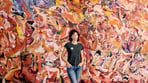
The Turner Prize 2025, the most famous contemporary art prize in Britain, has just been awarded to Nnena Kalu, the first artist with a disability to receive it, for her brightly coloured structures made from recycled fabric, plastic film and VHS tape, forming nest-like or cocoon-like forms that completely transform the space.

TO KNOW - Gerhard Richter turns a material against itself
Today I wanted to tell you about a work I particularly loved at the Fondation Louis Vuitton, in the exhibition dedicated to Gerhard Richter, for what it says and questions rather than for what it “is”. Get ready, it’s a very discreet piece…
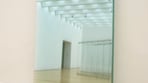
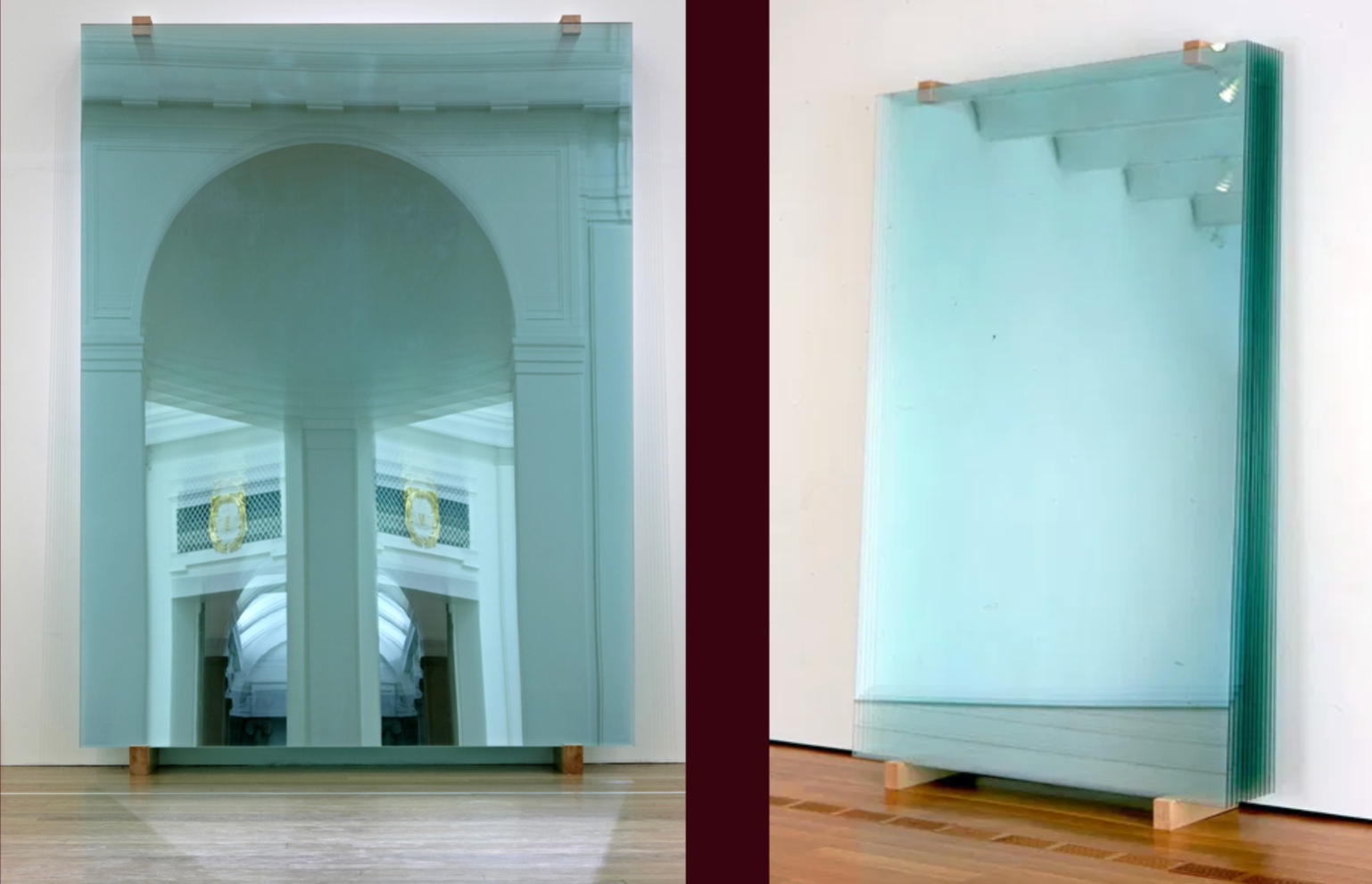
It’s 11 Scheiben by Gerhard Richter, 11 glass panels aligned one behind the other. No colour, no big narrative, no painterly “gesture” as we expect from him. It is clearly not one of his most “signature” works. At first glance, you could easily mistake it for a bit of architecture, a piece of exhibition design.
But what I find fascinating here is that Richter takes glass, with all its usual characteristics, and flips them one by one. He turns reality on its head.
Normally, glass is transparent. Here, because of the superposition of the panels, it becomes a mirror. The more you move, the more you see your own reflection. Glass no longer disappears, it asserts itself.
Normally, glass is fragile. Here, on the contrary, these 11 panels form a massive visual block.
Normally, glass suggests something light, airy. With Richter, it becomes heavy, dense, grounded. You no longer send your gaze straight through it, you have to walk around it with your body.
With 11 Scheiben, he shows very concretely that what we take for granted can be reversed. A material we associate with transparency, fragility and lightness turns, before your eyes, into a mirror, a block, an obstacle.
When you remember his story, it makes even more sense. Born in 1932 in Dresden, Richter grows up under Nazism, sees the war, the destruction of his city, then lives in communist East Germany before fleeing to the West in 1961. Two systems, two propagandas, two official versions of reality, and in the middle of it all, an artist who learns very early to distrust anything that claims to be “the truth”.
That’s why, in his work, reality is always blurred: blurred photographs, ambivalent abstractions, nuanced grey monochromes…
In these 11 glass panels, he doesn’t tell the story of war or politics. He does something simpler and more radical: he turns an everyday material into a device that forces you to doubt what you’re seeing.
Moral of the story: reality is not something stable, but a game of biases, points of view and interests. If we don’t take the time to really look, to check, to actually inform ourselves, we can completely miss the point… and let ourselves be fooled by appearances. In the current political climate, it feels important to say it out loud.
THE GOSSIP - Better a forger than a traitor, right?
In the category “you couldn’t make this up”, let me introduce Han van Meegeren.
Context: the Netherlands, post-war. The man is arrested. He is accused of having sold a Vermeer to the Nazis. In other words, collaboration. Bad timing, bad reputation, things are looking very, very bad for him…
Except van Meegeren finds a rather spectacular emergency exit.
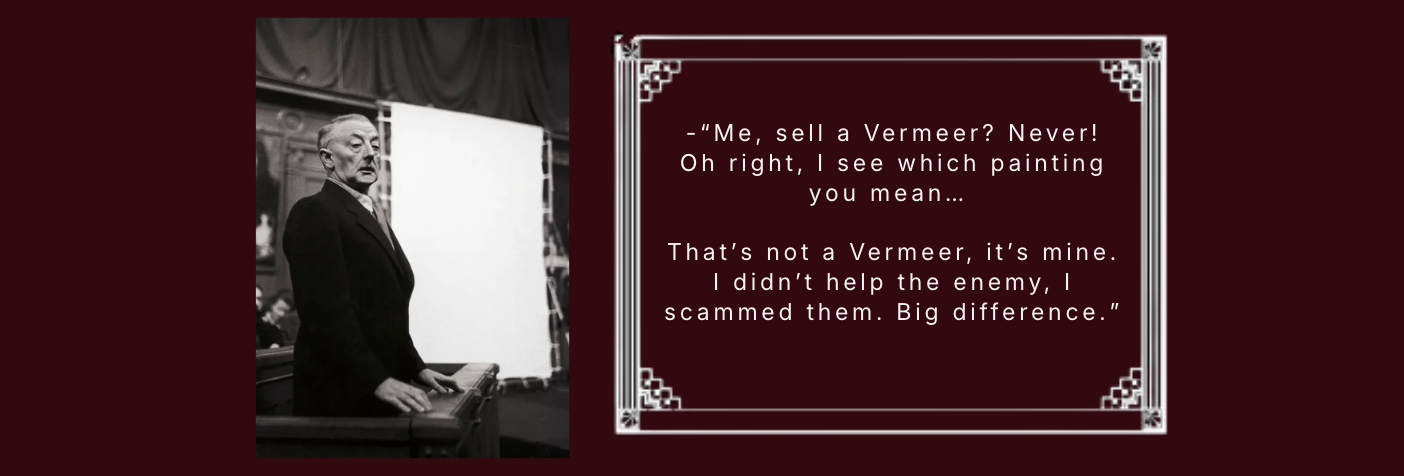
All right, he probably didn’t say it exactly like that. At least we have no proof.
But what we do know is this: he admits to being a forger. At that point, anything is better than being branded a traitor.
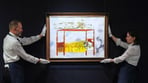
And to prove that he really did paint those “Vermeers”, he agrees to produce a new canvas under judicial supervision in the autumn of 1945. He paints a new fake Vermeer titled Jesus Among the Doctors (below), in front of witnesses. A full-on courtroom performance before performance art had a name: palette, pigments, staging, and a fake painting coming to life, legally, in front of everyone.
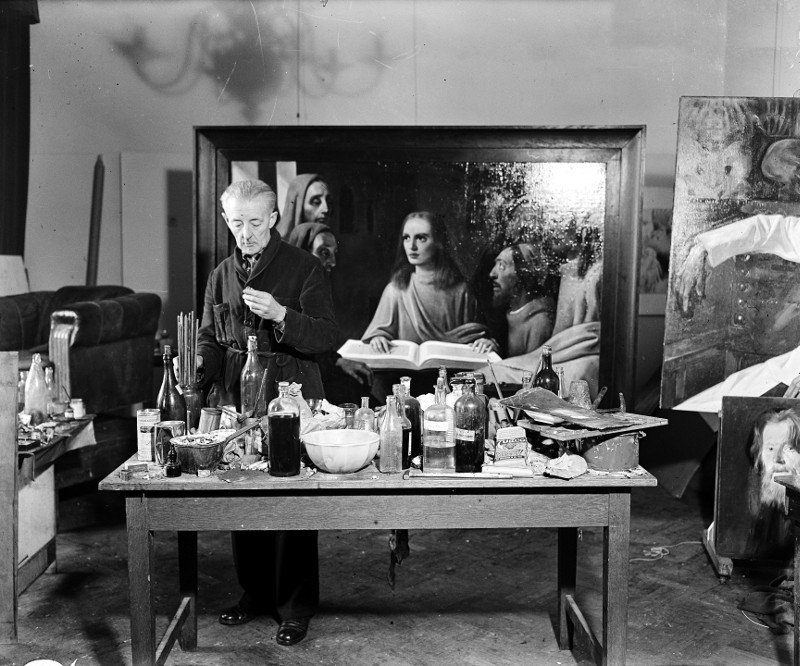
Van Meegeren then becomes almost a celebrity, a national hero even, and his case remains a darkly satisfying reminder that, in this story, it is the Nazis who end up humiliated - and we’re not exactly sorry about that.
If you want to savour the whole thing: you can read the full story here, and, best of all, see the fakes, because he didn’t stop at just one, the rascal.
In the end, he is still tried the following year as a simple forger, sentenced to one year in prison… a sentence he never serves, as he dies before it can be carried out.
THIS WEEK’S RECS
in New York :
Museum : Man Ray: When Objects Dream, The Met, until February 1, 2026. Rayographs, objects, images that look like they’re thinking for themselves. It’s good for the brain.
Gallery : Ana Mendieta: Back to the Source, Marian Goodman Gallery, until January 17, 2026. This show reveals how Ana Mendieta, exiled from Cuba, literally merged her body with earth, water, fire and stone to turn the landscape into an intimate political stage.
in Paris :
Museum : George Condo, Musée d’Art Moderne de Paris, until February 8, 2026. A major retrospective spanning more than forty years of work. It’s the perfect moment to see how Condo takes all the codes of art history (Rembrandt, Goya, Picasso, Rodin) and pulls them apart, recombining them into a mental, fractured kind of painting. Fractured in every sense of the word…
Gallery : The House on Utopia Parkway: Joseph Cornell’s Studio Re-Created by Wes Anderson, Gagosian, until March 14, 2026. Wes Anderson recreates Joseph Cornell’s New York studio inside the gallery: a fake studio, real film set, where you literally walk inside a Cornell box directed by Anderson.
to watch :
Made You Look: A True Story About Fake Art. To stay on the forger theme, this documentary tells the wild story of the biggest art fraud in US history. Featuring (fake) Rothkos, Pollocks…
See you next week… same day, same time!
Juliette,
To get in touch: info.midnightartclub@gmail.com
...
Midnight Art Club - L'art mis à nu
Midnight Art Club - L'art mis à nu